


Moving Abroad Checklist: Everything You Need to Plan


Moving to another country is one of those decisions that sounds exciting right up until you start making the actual list of things to do. Then it gets real. Visas, shipping, bank accounts, healthcare, schools, leases - the to-do list is longer than most people expect, and the order in which you tackle it matters.
The good news is that most of it is manageable if you start early and stay organized. A solid moving abroad checklist acts as your roadmap - it keeps you on track, reduces the chance of missing something important, and means you're not trying to cancel your electricity contract from an airport lounge at 6 am. The difference between a chaotic move and a smooth one usually comes down to how many weeks in advance you started - most people underestimate this by at least a month. Here's how to break it down!
How to Move to Another Country: Where to Start
The first thing to get right is the legal side. Every country has its own rules about who can enter, how long they can stay, and what they're allowed to do there. This is where how to move to another country actually begins - not with packing, but with visas and residency options.
Some countries offer straightforward paths for skilled workers. Others require a job offer, a significant financial investment, or a specific visa category that fits your situation. Before you do anything else, make sure you know how you can legally live in the country you're planning to move to - and for how long.
Once you've identified the legal entry point, consider the practical realities of daily life. Is there local work available, or will you need to be a remote worker? If you have kids, what does the school system look like? And then there are the less glamorous things to consider when moving to another country - local laws, how the healthcare system works, and whether your home country has a tax treaty with your new one. These details aren't exciting, but sorting them out early prevents surprises later. It's also worth checking whether your professional qualifications are recognized in the new country - a medical license, teaching certificate, or engineering credential from home doesn't automatically transfer, and some re-certification processes take months.
Legal Documents and Visa Planning
The visa is the foundation of everything. Get this wrong, and nothing else matters. You need to identify the right visa category for your situation - digital nomad, employee, student, or retiree - because each has different rules. A digital nomad visa typically doesn't let you work for local companies. A work visa is usually tied to a specific employer. Understanding these limitations before you apply saves a lot of trouble.
How to prepare to move to another country properly means gathering your paperwork early. Most countries will ask for:
- A valid passport - typically with at least 6 to 12 months of validity remaining
- Financial proof - bank statements showing you can support yourself
- Background checks - police clearance certificates from countries you've lived in recently
- Medical records - sometimes including specific vaccinations or health screenings
Visa timelines vary a lot. Some applications are approved in weeks, others take months. Build this into your planning window and keep a digital and physical folder for every document. A missed deadline or an expired certificate can mean starting over from scratch - and potentially pushing back your entire move. If you're applying from inside your current country, some consulates require in-person appointments that can be booked out weeks in advance - factor that into your timeline early.
Financial Preparation Before Moving Abroad
Moving overseas costs more than most people budget for. The plane ticket is just the beginning. You also need to cover the cost of shipping your belongings, a security deposit for a new apartment (which is often higher for foreigners), and a real emergency fund for the unexpected. A general rule: have at least three to six months of living expenses saved before you leave.
On the banking side, do your research before you go. Some international banks let you open an account before you arrive. Others require a local address. Also, look at how currency exchange rates will affect your day-to-day budget - if you're earning in one currency and spending in another, a market shift can change your financial picture overnight.
Cost of living research is one of the most overlooked things to consider when moving to another country. A salary that feels generous in your current city might not stretch as far as you think in a new one. Look at the actual price of rent, groceries, transport, and utilities. Use comparison sites to ground your budget in real numbers, not assumptions. One often-missed expense is the cost of setting up a new home from scratch - furniture, kitchen basics, bedding, and household supplies add up quickly when you don't have any of it yet.
Housing, Healthcare, and Insurance Setup
Finding a place to live is usually where the stress peaks. For moving overseas, the safest approach for most people is to book a short-term rental for the first month. It gives you time to see neighborhoods in person, understand commute times, and find an apartment that actually fits your life - rather than signing a year-long lease based on photos and a virtual tour.
Your expat checklist needs to include healthcare before you leave, not after you arrive. Depending on where you're going, you may be able to access the local public health system, or you may need private international health insurance. Many visa applications require proof of coverage, so this often needs to be sorted out as part of the legal process.
Insurance for your belongings is worth thinking about, too. It's the scenario most people don't plan for - a burst pipe destroying furniture, a laptop stolen from your apartment, a car accident in the first month. Without coverage, these situations drain savings fast. Getting renters' insurance or contents insurance early on is a straightforward way to protect yourself while you're still finding your feet. If you're shipping belongings internationally, make sure your insurance policy specifically covers goods in transit - standard home contents policies often don't, and replacement costs for items damaged during a long-haul move can be significant.
Career, Education, and Family Planning
Moving abroad with a partner or children adds another layer to the planning. For families, schools are usually the first thing to research - whether to send children to an international school with an English-language curriculum or enroll them in a local school for full immersion. Both approaches work, but they come with different costs and social trade-offs worth weighing carefully.
For your own career, try to have something secured before you leave - a signed contract, confirmed remote work arrangement, or at least a clear pipeline of interviews. If you're a remote worker, check that your employer is legally able to pay you from another jurisdiction. Tax rules around remote work have tightened in many countries, and this is not an area where assumptions work out well.
If you're moving with a partner, check what their visa allows. In some countries, a dependent visa doesn't allow work. If you're planning a long stay, understand the pathway to permanent residency or citizenship, and what the requirements are at each stage. For families moving to the US specifically, it's worth researching school district boundaries before you choose a neighborhood - in many cities, the district matters as much as the address.
How to Live Abroad for a Few Months: Short-Term Planning
Not every international move is permanent. Sometimes you want to try somewhere new for a season before committing to a full relocation. If you're looking at how to live abroad for a few months, your approach will be different from someone planning to stay indefinitely.
Many countries now offer digital nomad or short-stay visas that allow for 90 to 180 days - a useful way to experience a country properly before deciding whether it's the right long-term fit.
For short-term moving overseas, flexibility is the priority:
- Flexible housing - monthly furnished rentals, Airbnb, or co-living spaces designed for nomads
- Travel insurance - make sure it covers the full duration of your stay, not just the first few weeks
- Communication - a local SIM card or an eSIM for data keeps you connected without roaming charges
Keep your home-country bank accounts and phone number active. Don't ship your furniture. Keep your lease if you can. The goal is a clean, reversible setup so that returning home is just as easy as leaving. A short-term stay is also a good opportunity to test whether your remote work setup actually functions well in a different time zone - internet reliability, meeting schedules, and overlap hours are worth experiencing firsthand before you commit to anything longer.
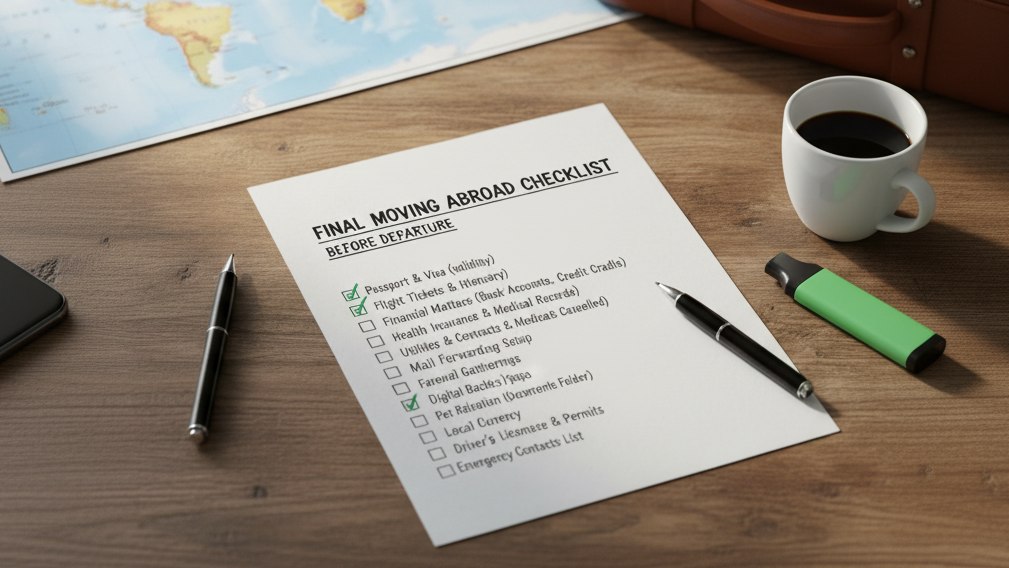
Final Moving Abroad Checklist Before Departure
As the departure date gets close, the pace picks up. In the final two weeks, work through the remaining items on your moving abroad checklist and make sure nothing slips through the cracks.
Confirm all travel arrangements and create digital backups of every important document - passport, visa, insurance policy, birth certificate. Store them in a secure cloud folder you can access from anywhere. Physical copies in your carry-on are also a good idea.
Then notify the right people:
- Your bank - so your card isn't flagged as suspicious when foreign transactions start showing up
- Government agencies - for tax and voting record purposes
- Service providers - cancel the gym, internet, electricity, and any subscriptions tied to your current address
The last piece is mental preparation. Moving overseas is a social shift, not just a logistical one. Before you leave, put together a rough plan for your first month - an expat community group to join, a language class to sign up for, a way to meet people outside of work. A house in a new country becomes a home a lot faster when you have a few familiar faces in it. The first few weeks abroad often feel busier and more disorienting than expected - having even one or two things pre-planned for your social life takes some of that pressure off and makes the transition feel less like starting from zero.
At Expat US, we help individuals and families navigate every step of relocating to the United States - from housing search and school enrollment to visa guidance and settling-in support. Book a call with our team to make your move as smooth as possible.

