


How to Rent a Car in the USA as a Foreigner


America is big. Genuinely, almost incomprehensibly big, and outside of New York, Boston, and a handful of other dense urban centers, a car is a necessity. If you’re arriving as an expat, a business traveler, or someone in the middle of a full relocation, figuring out how to get behind the wheel quickly is often one of the first practical problems you need to solve.
The good news: renting a car in the US as a foreigner is genuinely straightforward, as long as you walk into the rental counter with the right documents and a basic understanding of how insurance works in this country. Most major rental companies serve international customers, and the process is well established.
The catches are real, though. Insurance works differently here than in most of the world. Some rental companies have strict rules about non-English licenses. And the age surcharge system will surprise drivers under 25. Let’s figure out everything you need to know about car rental in the USA for foreigners - from what documents to carry to how to avoid paying twice for coverage you already have.
Can a Foreigner Rent a Car in the USA?
Yes. Can a foreigner rent a car in the USA? Absolutely, and it happens millions of times a year. International visitors account for a significant portion of rental car customers at major US airports, and the big rental companies are set up to handle it.
Can a foreigner rent a car in the USA on any type of visa? In most cases, yes. It doesn’t matter whether you’re here on a tourist visa, a work visa, or somewhere in the middle of a relocation process - your immigration status is not what determines eligibility. What matters is your age, driver’s license, and payment method.
Can a tourist rent a car in the USA on a B-1/B-2 visa? Yes, a standard tourist visa is no barrier whatsoever. Students on F-1 visas, business travelers, and temporary workers on L-1 or E-2 visas - all of the above can walk up to a rental counter and drive away, provided they meet the basic requirements.
Those requirements are:
- Age: Most companies require drivers to be at least 21 years old. Drivers between 21 and 24 typically face a young driver surcharge - usually $25-$35 per day - which adds up on longer rentals. At 25, the surcharge disappears. A handful of companies rent to drivers as young as 18, but they’re the exception.
- Valid driver’s license: More on this below.
- Credit card in the driver’s name: Debit cards are accepted at some companies, but usually trigger a larger deposit hold and sometimes a credit check.
Can a foreigner rent a car in the USA without a credit card? Some companies accept debit cards, but the process is more complicated, and the deposits are higher. A credit card in your own name remains the path of least resistance.

Can I Rent a Car in the US with a Foreign License?
Can I rent a car in the US with a foreign license? Yes, your home country license is valid for renting and driving in the United States. American law recognizes foreign licenses for visitors, and rental companies are accustomed to processing them.
That said, there’s a practical complication: if your license is not in English and not printed in the Latin alphabet, many rental companies will require an International Driving Permit (IDP) alongside it. An IDP is simply a standardized multilingual translation of your license - it’s not a standalone document, and it doesn’t replace your actual license. Still, it acts as an official translation that rental agents and law enforcement can read.
Even when it’s not strictly mandatory, carrying an IDP is a smart move. If you’re involved in an accident and your license is in Arabic, Chinese, or Korean, an IDP removes a significant potential complication. Getting one before you leave your home country is easy - they’re issued by national automobile associations in most countries for a small fee.
Can I rent a car in the US with a foreign license that’s been issued recently? Most companies require your license to have been valid for at least one year. A brand-new license - even from your home country - may be declined, and surcharges for newer license holders are common.
Car rental license requirements in summary: your license must be valid, either printed in English/Latin script or accompanied by an IDP, and held for a minimum of one year. Beyond that, requirements vary by company, which brings us to the next section.
Can I Rent a Car with a Passport Only?
Can I rent a car with a passport instead of a driver’s license? No, a passport proves your identity, not your driving ability, and rental companies require both. You’ll need your passport as your primary ID document (especially important if your license doesn’t include a photo or is in a non-Latin script), but it sits alongside your license, not in place of it.
Some rental companies also require a return flight ticket when processing international renters, as proof that you’re a legitimate visitor. This is more common at smaller regional companies than at major chains, but it’s worth knowing.
The payment method matters too. Most companies place a temporary hold on your credit card at pickup - typically $200-$500, sometimes more for luxury vehicles - that is released when you return the car. This hold can be a problem with debit cards and prepaid cards, which is one reason a proper credit card in your name is genuinely important.
Car Rental License Requirements by Company
Car rental license requirements vary more than most people realize, and checking the specific policy of your chosen company before you book can save a frustrating conversation at the counter.
A quick snapshot of the major players:
- Enterprise and National are generally flexible with foreign licenses and accept them without an IDP in many situations, particularly for licenses in English or Latin script. Their international renter policies are clearly documented online.
- Hertz has a more explicit requirement for an IDP when the license is not in English - it’s listed clearly in their terms for international renters. They’re strict about this at major airport locations.
- Avis and Budget (both owned by the same parent company) fall somewhere in the middle - they accept many foreign licenses but recommend an IDP as a precaution. Their policies can also vary by state, which adds a layer of complexity.
- Alamo tends to be one of the more international-friendly options and is widely used by tourists booking through package travel platforms.
The practical advice: don’t assume. Visit the company’s website, find the international renter section, and read it for your specific license country. Five minutes of research before booking prevents the worst-case scenario of arriving after a 10-hour flight to find your reservation can’t be honored.
Insurance and Costs When Renting a Car as a Foreigner
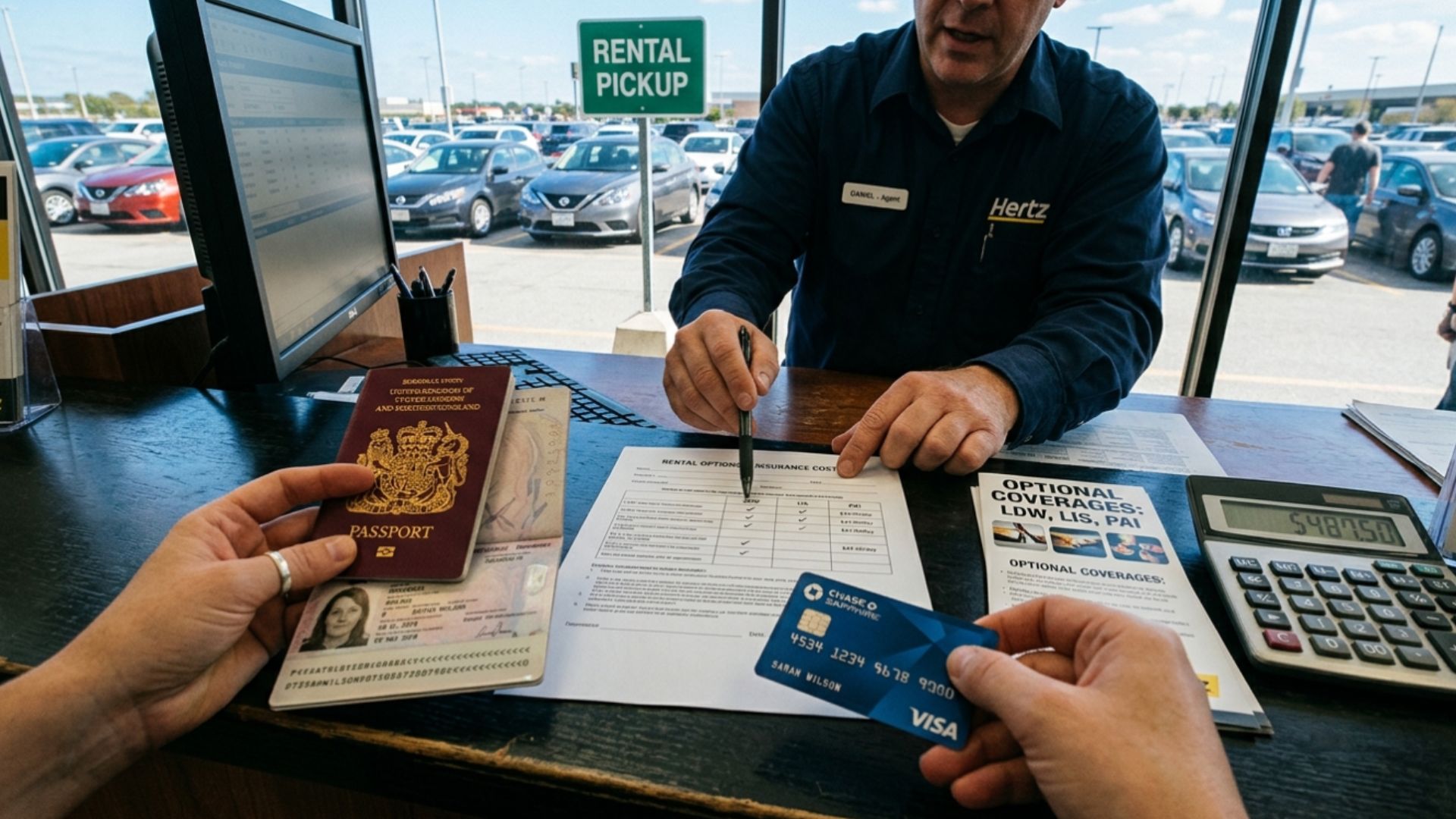
This is the section that costs people the most money when they’re unprepared. Car rental in the USA for foreigners almost always involves navigating an insurance conversation at the counter, and the agents are trained to make the add-ons sound essential.
Here’s what’s actually on offer:
- Collision Damage Waiver (CDW): Covers damage to the rental car itself. It’s the most commonly purchased add-on - typically $15-$30 per day.
- Supplemental Liability Protection (SLP): Covers damage you cause to other people’s property or injuries. Rental cars come with minimum state-required liability coverage, but it’s often very low. This tops it up.
- Personal Accident Insurance: Covers medical expenses for you and your passengers after an accident.
- Personal Effects Coverage: Covers theft of belongings from the car. Almost nobody needs this separately - travel insurance typically covers it.
The truth about car rental in the USA for foreigners: most foreign auto insurance policies do not extend to US rentals. Unlike within the EU, where coverage often crosses borders, your policy from France or Brazil almost certainly doesn’t help you here.
However, two things may already cover you that are worth checking before you pay the rental counter’s rates:
- Your travel insurance policy. Many comprehensive travel insurance plans include rental car coverage. Read the terms carefully - some require you to decline the rental company’s CDW for their coverage to kick in.
- Your credit card. Many Visa and Mastercard credit cards (particularly premium tiers) include rental car collision coverage as a cardholder benefit, provided you pay for the entire rental with that card. This is worth a five-minute call to your card issuer before you travel.
If neither of these applies, buying the CDW and SLP from the rental company is the sensible choice. Skipping liability coverage entirely to save $20 a day is not a trade-off worth making in a country where a minor accident can generate enormous legal costs.
Top Tips for Renting a Car in the US as a Foreigner
After 19 years of helping expats arrive and settle in the US, our consultants have seen every rental car situation imaginable. Here’s what actually matters:
- Book online before you arrive. Prices at the counter are almost always higher than pre-booked rates. Comparison platforms like Kayak, Rentalcars.com, and the company’s own website typically offer better rates, and you can filter by policies that are international-renter-friendly. Renting a car in the US as a foreigner is smoother when you’ve already confirmed the company’s policy for your specific license type before you land.
- Carry everything in one place. At pickup, you’ll need: your passport, your foreign driver’s license, your IDP (if applicable), the credit card you booked with, and your reservation confirmation. Missing any one of these can significantly delay the process.
- Understand toll systems before you drive. Most US highways use electronic tolling - E-ZPass in the Northeast, SunPass in Florida, FasTrak in California, and several others. Rental companies offer toll transponder add-ons, or they’ll bill tolls to your card after the fact (with an administrative fee). Knowing which system covers your route before you leave the lot is worth a few minutes of research.
- Check the fuel policy. Most rentals use a “full to full” policy - you receive a full tank and return it full. Some offer a prepaid fuel option that’s rarely good value. Return the car with a full tank.
- Learn the basics of local traffic rules. Right turn on red is permitted in most states unless posted otherwise. Speed limits on highways vary by state. School zone rules are strictly enforced. None of this is complicated, but being aware before you pull out of the lot is better than discovering it on the road.
If you’re in the middle of a bigger US relocation - figuring out neighborhoods, setting up your home, enrolling kids in school - renting a car in the US as a foreigner is often the first independent thing you’ll do, and it sets the tone for everything that follows. Our Settling-In Services cover the practical layers around it: local orientation, transport options, and helping you understand the city before you’re navigating it alone.
And if you’re still in the early stages of planning your move, our blog posts are a good place to start - they cover the full picture of what to expect in those first weeks in a new city. Questions? Talk to our team.

