


E-2 Visa for Investors and Entrepreneurs: What You Need to Know


Most US work visas require an employer to sponsor you. The E-2 takes a different approach entirely: you are the investor, you build the business, and your right to stay in the country is tied to that company’s performance. It’s one of the few paths that gives entrepreneurs genuine control over their own immigration status.
This guide covers the full picture for investors, entrepreneurs, and the advisors supporting them. By the end, you’ll have a clear sense of who qualifies for the E-2 investor visa, what the financial and documentation requirements actually look like in practice, how long the process takes, and what your long-term options are if you eventually want to stay permanently.
What Is an E-2 Visa?
The simplest answer to what an E-2 visa is: it’s a nonimmigrant visa that allows citizens of qualifying treaty countries to enter the US specifically to invest in and manage a real, active business. You don’t need a US employer. You fund the enterprise, you run it, and your immigration status is directly tied to that business’s continued operation.
Understanding what E-2 is in practical terms also means understanding its limits. This category is temporary and does not carry dual intent, which means you can’t use it as a staging ground for permanent residency without a separate legal strategy. That said, it can be renewed indefinitely as long as the business remains viable, which gives long-term investors a stable foundation even without a direct green card path built in.
Who Can Apply for an E-2 Visa
Eligibility for the E-2 investor visa is tied to nationality, not profession. You must be a citizen of a country that holds a qualifying treaty with the United States. The US maintains such treaties with dozens of nations, but not all countries are included, so the first step for any applicant is confirming their country is on the list.
Beyond nationality, the investor must own at least 50 percent of the US business, or hold full operational control through a senior management or directorship role. A company from a treaty country can also bring in key employees under the same framework, provided those employees hold the same nationality and possess specialized skills the enterprise genuinely requires to operate.
Family provisions are straightforward and generous. The main applicant’s spouse and unmarried children under 21 can accompany them. Spouses are eligible for work authorization and can work for any US employer, not only the treaty enterprise. Children can attend public or private schools. This makes the E-2 significantly more family-friendly than many other temporary categories.
E-2 Visa Requirements
The core E-2 visa requirements center on three things: the nature of the business, the investment itself, and the investor’s level of commitment.
The business must be real and active. Passive investments, vacant land, undeveloped property holdings, and stock portfolios don’t qualify. The enterprise needs to produce goods or provide services in an ongoing commercial capacity.
The investment must be “at risk,” meaning the money is genuinely committed to the business, not sitting in a personal account waiting to be deployed. Signing leases, purchasing inventory or equipment, and funding operations are all evidence of an at-risk investment. A promise to invest later will not satisfy the E-2 visa requirements.
The business also cannot be what immigration officers call “marginal,” meaning it cannot exist solely to provide a living for the owner’s household. The enterprise needs to demonstrate current or credible future capacity to generate income beyond the owner’s personal needs and, ideally, to create employment for US workers.
Investment Amount Requirements
There is no fixed minimum E-2 visa investment amount, which surprises most first-time applicants. Instead, USCIS and consular officers apply what’s called the “proportionality test”: the investment must be substantial relative to the total cost of the business.
In practice, this means a low-overhead consulting business might require the investor to have committed close to 100 percent of startup costs to demonstrate seriousness. A restaurant or manufacturing operation with higher startup costs naturally requires a larger absolute figure but may satisfy proportionality at a lower percentage.
As a general reference point, most successful E-2 applications involve an E-2 visa investment amount somewhere in the range of $100,000 to $200,000 for small service businesses, with significantly higher figures for capital-intensive enterprises such as hotels, production facilities, or large retail operations. The key is that the amount must be plausible for the type and scale of the business described in the application.
Business Plan Requirements
The E-2 visa business plan is, in many ways, the centerpiece of the application. It’s the document that ties everything else together: the investment, the job creation projections, the market rationale, and the financial viability of the enterprise.
A strong E-2 visa business plan should include a detailed market analysis specific to the industry and location, a five-year financial forecast with realistic assumptions, a clear breakdown of how investment funds are being deployed, and a staffing plan that shows how the business will create US employment over time.
Officers read these plans carefully and with some skepticism. A generic, template-style plan that doesn’t reflect the actual market or the business’s specific operations is one of the most consistent reasons for delays and denials. The E-2 visa business plan needs to tell a coherent and credible story about why this business, in this market, run by this investor, will succeed.
E-2 Visa Application Process and Documents
The application process for the E-2 investor visa begins well before any forms are submitted. The business must actually be established: legally registered, bank accounts opened, investment funds committed to legitimate business expenses, and operations underway or ready to launch.
Once the business is in place, applicants outside the US file Form DS-160 and attend an interview at a US consulate or embassy. Those already inside the US on a valid nonimmigrant status can file Form I-129 to change status without leaving the country.
Supporting documentation typically includes proof of citizenship, evidence of the investment and its source (bank statements, purchase receipts, signed leases), corporate formation documents, and the E-2 visa business plan. Requirements vary somewhat by post, so checking the specific consulate’s guidance before submitting is worth doing carefully.
Do You Need an E-2 Visa Attorney
For most investors, working with an experienced E-2 visa attorney is the right call. The category involves enough discretion on the part of adjudicating officers that the framing of the application genuinely matters. A well-structured petition from a qualified E-2 visa attorney positions the investment favorably, preempts common objections, and builds a record that supports future renewals.
That said, the level of legal complexity varies with the situation. A straightforward single-owner investment in a clear-cut business category with clean source-of-funds documentation is more manageable than a multi-owner structure with international funding sources or a business type that requires additional justification. In either case, getting the setup right from the beginning is considerably less expensive than correcting problems at renewal.
E-2 Visa Processing Time and Interview
E-2 visa processing time varies significantly depending on where and how you apply. Applicants filing inside the US who are eligible to change status can use USCIS Premium Processing, which guarantees a decision within 15 business days. Standard USCIS processing takes roughly two to three months.
Consular processing abroad adds a different variable: appointment availability. Some US embassies have short wait times; others have interview slots booked months out. The total E-2 visa processing time through a consulate can range from three months to upward of eight months in high-demand locations.
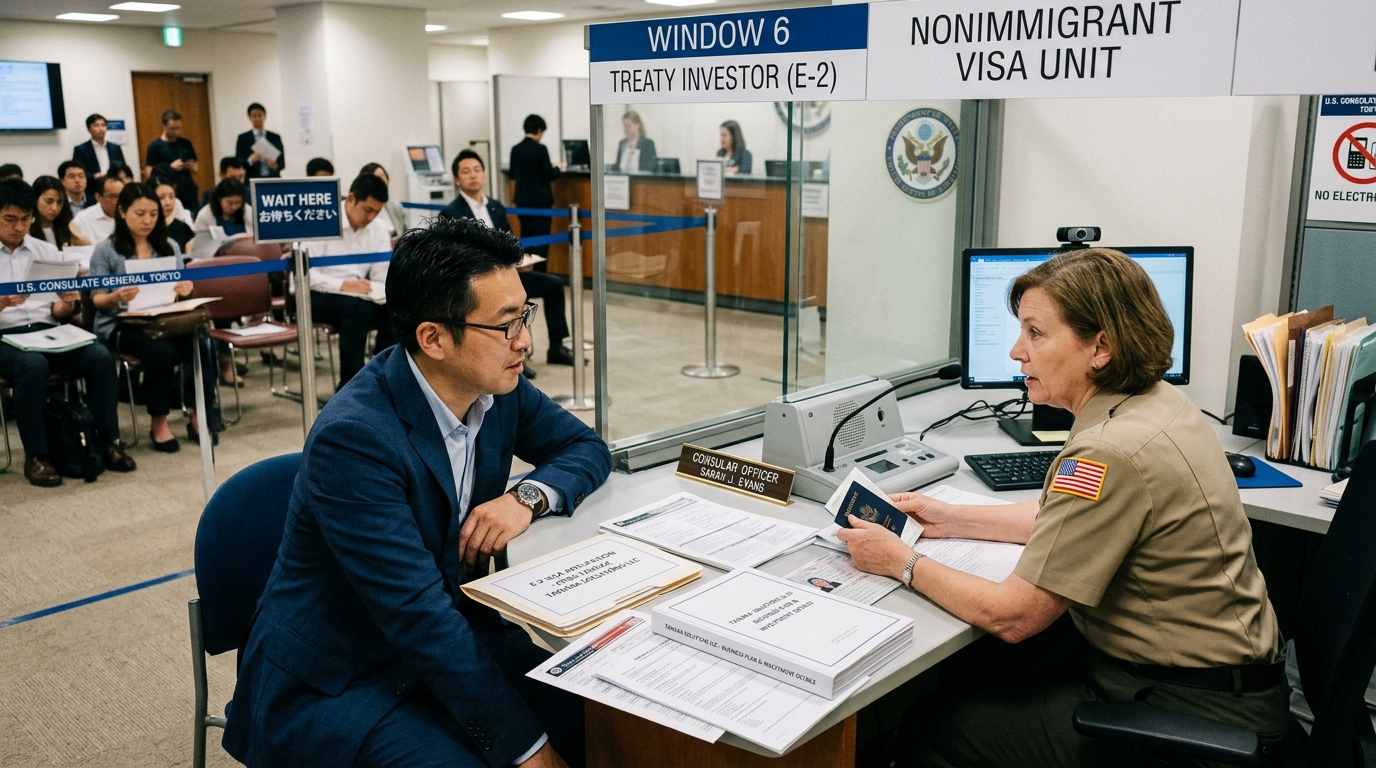
The interview itself is substantive. Officers ask detailed questions about the business model, the source of funds, and the investor’s day-to-day operational role. Applicants should know their financials, their business plan, and their operational structure well enough to discuss them naturally. Inconsistencies between the written application and verbal answers are a common and avoidable source of denials.
Common E-2 Visa Interview Questions
Being well-prepared for E-2 visa interview questions matters as much as having strong documentation. Officers will typically ask where the investment funds originated and how they were transferred into the US business. They’ll ask what the investor’s specific daily responsibilities are and how the business generates revenue.
Other common E-2 visa interview questions include: how many employees are currently working or planned, what makes the business competitive in its local market, and what the five-year growth trajectory looks like. These questions directly mirror the content of the business plan, which is why that document needs to be something the investor genuinely knows and believes in rather than a document prepared by someone else and submitted without review.
E-2 Visa Renewal: Staying Current as an Investor
Initial E-2 status is granted for two to five years depending on the treaty country. The E-2 visa renewal process requires demonstrating that the business is still operational, still non-marginal, and still consistent with what was outlined in the original application.
At E-2 visa renewal, USCIS or the consulate will review updated financial records: tax returns, bank statements, payroll documentation, and evidence of continued operations. Investors whose businesses have grown, created US employment, and stayed current on tax obligations are generally in a strong position. Those whose businesses have stagnated or whose records are incomplete face more scrutiny.
Starting the renewal process at least six months before the current status expires is standard practice. Gaps in status create complications that are difficult and sometimes impossible to resolve retroactively.
E-2 Visa to Green Card: Is There a Path to Permanent Residency
The question of the E-2 visa to green card is one of the most frequently asked and most frequently misunderstood in this category. The honest answer: there is no direct conversion. The E-2 is explicitly a nonimmigrant classification without dual intent, which means the category itself doesn’t offer a built-in route to permanent residence.
That said, permanent residency is achievable through parallel pathways. Investors who grow their operations significantly may become eligible for the EB-1C multinational manager green card if the corporate structure supports it. Those with larger capital to deploy may qualify for the EB-5 investor visa. In some cases, a family member’s sponsorship or employer-based petition in a separate capacity provides the path forward.
Planning for the E-2 visa to green card transition needs to happen early, ideally at the same time the business is being established, so the corporate structure doesn’t create obstacles later. An immigration attorney can map out which pathway aligns best with the investor’s business model and timeline from the outset.
Once your visa status is in place, the practical side of relocating to the US still needs attention: housing, local registration, banking, school enrollment for family members, and settling into a new city. Our settling-in services support investors and their families through exactly that process, and our visa assistance team can coordinate with your immigration counsel to align the relocation timeline with the application process.
Planning an E-2 investment and move to the US? Whether you’re an individual entrepreneur relocating with your family or an organization supporting investor transfers, reach out to our team for a free consultation. We’ll help you build a relocation plan that runs in parallel with your visa process, so the business launch and the practical move happen on the same timeline.

