


Employee Global Mobility: Key Types Explained

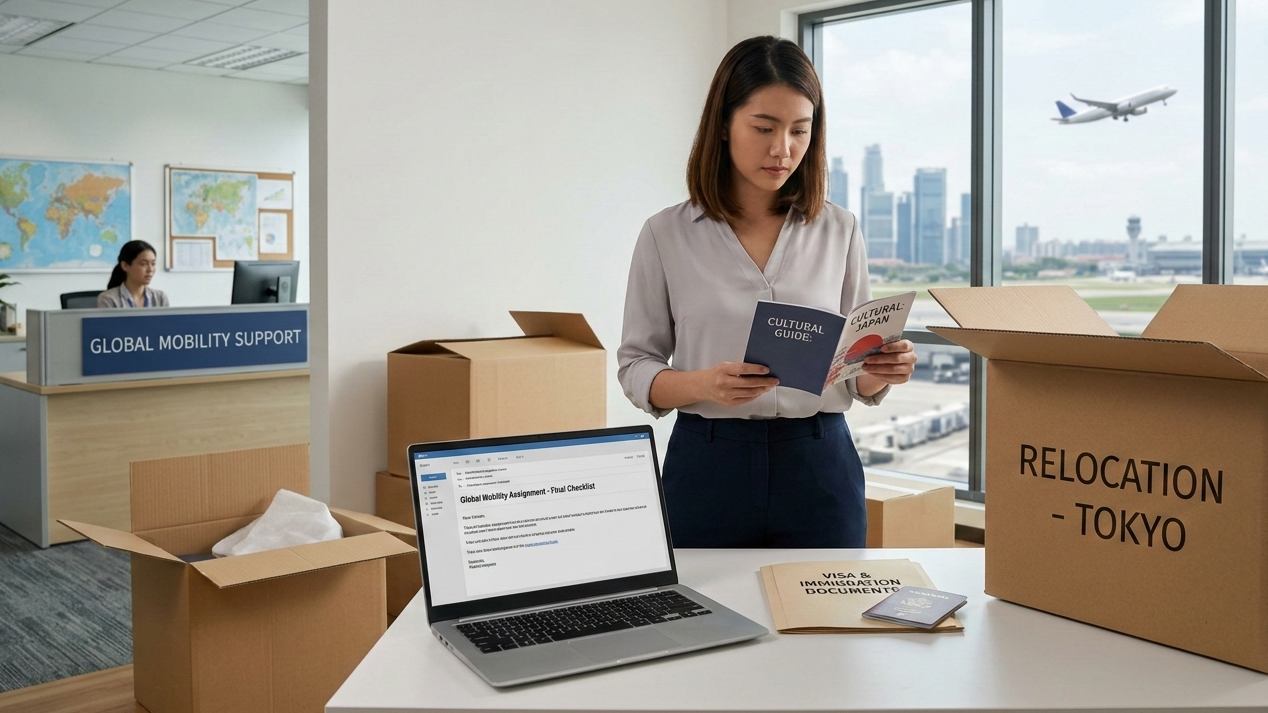
The ability to move people across borders has become a real competitive advantage for businesses of almost any size. It's not just something the biggest multinationals do anymore. Companies of all kinds are figuring out how to put the right person in the right location - whether that's for a six-month project, a long-term leadership role, or something in between.
When people talk about global mobility meaning, they're describing a company's ability to move employees to different offices or project sites around the world. It sits at the intersection of HR, logistics, and legal compliance - and when it works well, it lets companies quickly fill skill gaps, transfer knowledge between teams, and expand into new markets without starting from scratch. Instead of hiring someone new in a foreign country, you send a trusted person who already knows how the business works.
Understanding the different forms employee mobility can take is the starting point for any company thinking seriously about international growth.
What Is Global Mobility? Definition and Business Importance
To understand what this field actually involves, it helps to go beyond the simple definition. Global mobility meaning isn't just booking a flight and arranging a lease. It's the managed movement of employees across borders to meet specific business objectives. Traditional relocation focuses on getting someone and their family from A to B. Mobility is a broader HR function - one that connects talent decisions to the company's wider strategy.
The scope of employee mobility has changed a lot over the last ten years. It used to be reserved mostly for senior executives sent abroad on generous expat packages. Today, it includes junior developers on a six-month project, regional managers covering multiple countries, and remote workers who operate across time zones without ever being formally relocated.
Why does this matter for businesses?
- Access to talent. The best person for a role doesn't always live where the job is. Mobility lets companies bring that talent to where it's needed.
- Knowledge transfer. Sending an experienced person to a newer office is often the fastest way to build local capability. It's more effective than training alone.
- Employee retention. High performers often want international experience as part of their career. Offering that opportunity is a real reason for someone to stay with a company rather than look elsewhere.
- Market entry. Opening an office in a new city or country goes much more smoothly when a few core people who already understand the business model are on the ground from day one.
Even in a world where remote work is widespread, the physical movement of people retains real value. The cultural immersion, the face-to-face relationships, the informal learning that happens when someone is actually present - these are things a video call can't fully replace.
Why Companies Need a Strong Global Mobility Policy
Moving people across borders without clear rules is a fast way to create legal and financial problems. A global mobility policy is the framework that determines how employees are moved, what they're entitled to, and how the company stays on the right side of local laws.
A well-built global mobility policy covers several areas:
- Tax and compliance. Every country has different tax rules. If someone works in France for six months but is paid by a US entity, the question of who owes what to which government needs a clear answer. A policy ensures both the company and the employee remain compliant.
- Immigration. Getting the right visas and work permits is one of the most complex parts of any international move. The policy defines who handles the paperwork, who covers the costs, and the timeline.
- Compensation. Salaries don't automatically adjust when someone moves to a different country. The cost of living in Mumbai is very different from that in London. A policy sets out how Cost of Living Adjustments (COLAs) are calculated to ensure the approach is fair and consistent.
- Relocation support. This includes the practical side: shipping belongings, finding schools for children, covering temporary housing, and providing language training where needed.
There's a reason why standardizing global mobility policies matters beyond just tidiness. When companies handle relocations case by case, the results are unpredictable. Two employees at the same level receiving very different packages creates resentment and confusion - and it's a real legal risk, too. Consistent, transparent policies protect both the employee and the company, and they reduce the administrative chaos that comes with improvising each time.
Types of Global Mobility Assignments Explained
Not every move looks the same. Companies use different types of global mobility depending on their needs and the duration of the assignment. Here are the main models:
- Long-term international assignments typically run between one and five years. These are the classic expatriate roles - usually senior leaders managing a foreign branch, or specialists overseeing a large project. They're expensive, but they offer the deepest integration. The employee becomes genuinely embedded in the local culture and business environment in a way that shorter assignments can't replicate.
- Short-term assignments usually last between three and twelve months. This type works well for specific, time-bound work - a software team finishing a client rollout, a training specialist setting up a new department, an engineer supervising a construction phase. Because the employee often doesn't move their whole family or give up their home, these assignments tend to be simpler to manage.
- Permanent transfers are for employees moving to a new country with no expectation of returning to the original office. They become "localized," meaning local contracts, local benefits, and local tax treatment. This often happens when an employee wants to relocate for personal reasons, and the company has a permanent role for them in that location.
- Cross-border commuting and rotational shifts are common in industries like oil and gas, mining, and construction. An employee might work in a different country for three weeks and then fly home for three weeks. Others commute across borders daily - living in one country and working in another. These arrangements require careful management around tax and social security rules.
Understanding the types of global mobility available lets companies match the model to the situation, rather than forcing every move into the same structure.
What Are Global Mobility Services and How Do They Work?
What are global mobility services in practical terms? They're the specialized support functions that make international movement actually work. Moving an employee across borders involves enough complexity - legal, financial, logistical - that most companies rely on a mix of internal expertise and external specialists.
What are global mobility services typically made up of?
- Immigration support. Managing work permits, residence visas, dependent visas, and entry requirements for each specific country.
- Tax advisory. Helping employees navigate filing in two countries and ensuring the company isn't inadvertently creating tax obligations in places it didn't intend to.
- Destination services. Helping the employee find a home, open a local bank account, get a driver's license, understand public transport, and handle the dozens of small administrative tasks that come with settling into a new place.
- Repatriation planning. Getting someone home at the end of an assignment is often the most overlooked part of the whole process. Without proper planning, returning employees can feel disoriented and undervalued - which sometimes leads them to leave the company shortly after returning.
A professional global mobility team coordinates all of these services. They connect the employee with the right vendors - movers, immigration lawyers, tax advisors - and make sure nothing gets missed. Without that central coordination, the complexity of a move tends to fall on the employee, which creates stress, distracts them from their actual job, and often leads to assignment failure.
The Role of a Global Mobility Team in Modern Organizations
A global mobility team is typically a specialist group within HR, though in smaller companies, the function is sometimes handled by a generalist with support from external partners. Their role goes well beyond paperwork. They're strategic advisors who bridge the company's growth ambitions and the practical reality of international law.
A well-structured global mobility team usually includes people with backgrounds in relocation, immigration, and international payroll. They work across departments:
- With Finance - to track the full cost of assignments and ensure spending aligns with budget expectations. International moves are expensive, and the costs aren't always visible upfront.
- With Legal - to ensure the company is compliant with labor laws in every jurisdiction where it operates or sends employees.
- With Talent Management - to identify which employees have the adaptability and mindset to succeed in an international context. Not every high performer thrives when placed in an unfamiliar country.
Technology has changed how global mobility teams operate. Modern platforms can track where every employee is located in real time, which matters a lot for duty of care. If a natural disaster or political crisis happens in a city where employees are based, the mobility team needs to know immediately who is there and what steps to take. The same data helps teams demonstrate return on investment - showing business leadership that the cost of moving people translates into measurable outcomes.

Emerging Trends in Employee Global Mobility
The way companies think about work has shifted, and global mobility has shifted with it. The traditional model - company decides, employee moves - is still common, but it's no longer the whole picture.
Remote work has created a new category: the virtual assignment. An employee works for a foreign office without physically relocating. It's flexible and cost-effective, but it introduces complexity around what's sometimes called "shadow payroll" - the company may owe taxes in a country where it has no official presence, simply because an employee is working there.
Digital nomad visas are another development that companies are still figuring out how to handle. Countries including Spain, Portugal, Greece, and the UAE now offer specific visas for remote workers. This raises questions that most global mobility policy frameworks haven't fully answered yet. Can an employee base themselves in Bali while employed by a London company? Increasingly, the answer is yes - but the tax and legal implications need proper structure, not just a nod from a line manager.
There's also a growing trend toward employee-initiated mobility. Historically, the company decided where people went. Now, employees are increasingly asking to relocate for lifestyle reasons - a different climate, proximity to family, a lower cost of living - and expecting their employer to support it. Companies that build flexibility into their mobility framework have a real advantage in attracting people who could work anywhere.
Looking ahead, inclusion is becoming a more prominent consideration. There's growing awareness that international opportunities have historically gone to a fairly narrow demographic, and companies are actively working to change that. The types of global mobility available are expanding - becoming more varied, more personalized, and more driven by individual circumstances alongside business needs. The goal is a system in which the company's requirements and the employee's goals aren't in conflict but actually reinforce each other.
At Expat US, we support companies relocating employees to the United States - from housing search and temporary accommodation to settling-in services, school enrollment, and visa guidance. Book a call with our team to see how we can support your next assignment.

