


Your First US Paycheck: Taxes, FICA & Withholding


You negotiated a $90,000 salary. Your first paycheck arrives, and the number on it is nowhere near what you expected. Maybe $2,800 when you were mentally planning for $3,750. Where did nearly a thousand dollars go?
This moment catches almost every expat. The US tax system is genuinely different from what most people have experienced back home. And one of the biggest surprises sitting quietly on that pay stub? A line called FICA.
Our article breaks it down in plain terms: what it is, what it costs you, how it differs from income tax, and how to actually read that confusing document you’ll get every two weeks.
What Is FICA?
What is FICA? The acronym stands for the Federal Insurance Contributions Act - a mandatory federal payroll tax that funds two of America’s core social programs: Social Security and Medicare.
Here’s the first thing to understand: FICA is not optional, and it is not the same as income tax. It’s a separate deduction that comes out of your paycheck before you ever see a dollar. On top of that, your employer pays an equal matching contribution on your behalf, so the total flowing into the system is actually double what you personally see deducted.
The two parts are straightforward:
- Social Security (OASDI): Funds retirement, disability, and survivor benefits.
- Medicare: Funds federal health insurance for Americans aged 65 and older.
Both are calculated as a flat percentage of your gross wages - same rate regardless of income level (with one exception, covered below).
One question we hear from expats all the time is: “Do I actually benefit from paying this?” The honest answer: possibly yes, especially if you plan to stay in the US long-term.
FICA Tax: How Much Is It?
Let’s get to numbers. The FICA tax rate for employees is 7.65% of gross wages, split like this:
- 6.2% - Social Security.
- 1.45% - Medicare.
Your employer matches this exactly, making the total system contribution 15.3% of your salary. So how much is FICA in real dollars? On that $90,000 salary: roughly $6,885 per year, it’s about $265 per biweekly paycheck, gone before it reaches you.
Two things every expat should know:
- Social Security has a wage cap. In 2025, only the first $176,100 of earnings are subject to the 6.2% Social Security portion. Earn above that, and the Social Security deduction stops mid-year. The 1.45% Medicare portion, however, continues without a ceiling.
- High earners face an extra charge. If you earn over $200,000 (single filer) or $250,000 (married filing jointly), an additional 0.9% Additional Medicare Tax applies. Employers don’t always withhold this automatically; if your salary is in that range, flag it with a tax professional early.
For most expats arriving with standard employment packages, the FICA tax is a flat 7.65%. Build it into your budget from the very first paycheck.
What Is FICA on My Paycheck vs. Federal Income Tax?
This is where confusion usually peaks, and fairly so.
What is FICA on my paycheck? Open your pay stub, and you’ll typically see two separate line items: “FICA - Social Security” and “FICA - Medicare” (Social Security is sometimes labeled “OASDI”). Then, separately, you’ll see “Federal Income Tax” or “FIT.”
These are completely different systems. Is FICA federal income tax? No, and this distinction actually matters for how you plan:
Understanding what FICA on my paycheck means means accepting that those two lines are fixed costs - no W-4 adjustment, no deduction, no workaround. Federal income tax, on the other hand, is entirely adjustable depending on your filing status, dependents, foreign tax credits, and applicable tax treaties.
This matters practically: FICA is predictable. Budget for it once and move on. Federal income tax deserves more planning - particularly if your home country has a tax treaty with the US, which many do.
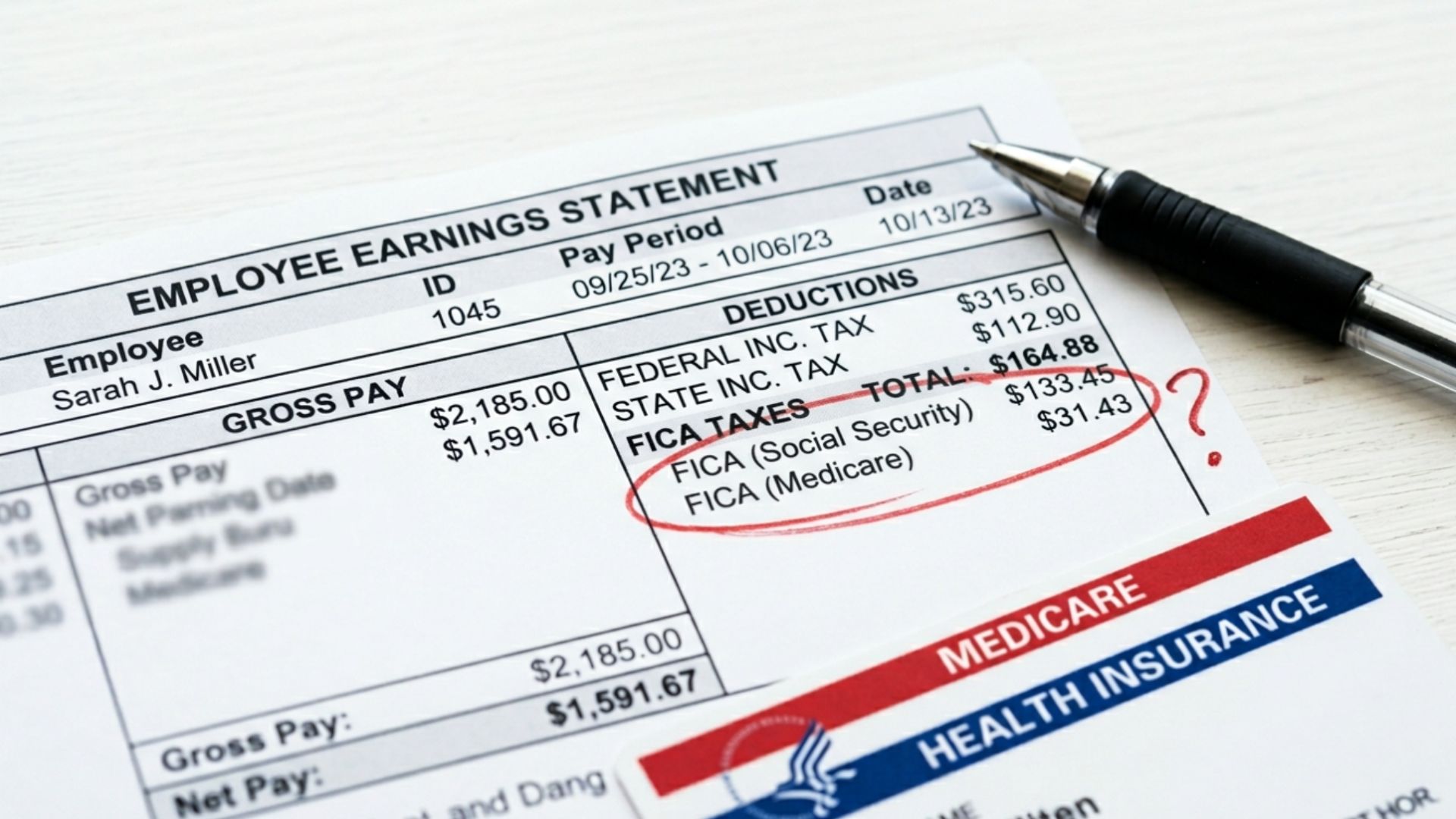
Does FICA Include Medicare?
Does FICA include Medicare? Yes! It does, making up 1.45% of the total employee contribution of 7.65%.
What does that 1.45% actually buy? Primarily, Medicare Part A eligibility (hospital insurance) is once you reach age 65, provided you’ve paid into the system for at least 10 years (40 quarters). If you’re relocating mid-career, those quarters start accumulating from your very first paycheck in the US.
For expats, this is more meaningful than it sounds at first. If you’re building a long-term life in the US, you’re building toward real benefits. If you’re here on a time-limited assignment, it’s worth investigating totalization agreements - bilateral treaties between the US and countries like France, Germany, the UK, and Australia that prevent double contributions to two social systems simultaneously, and may allow you to combine work credits from both countries.
The FICA tax portion going toward Medicare isn’t money thrown into a void. At Expat US, we’ve worked with hundreds of assignees who arrived for a two-year contract and are still here fifteen years later. The system starts making a lot more sense once you think of it that way.
Reading Your Paystub & Adjusting Your Withholding
Your US pay stub is basically a mini financial statement. Once you know how to read it, the anxiety fades pretty quickly. Here’s a typical breakdown:
- Gross Pay: your full salary before any deductions.
- FICA - Social Security: 6.2% of gross.
- FICA - Medicare: 1.45% of gross.
- Federal Income Tax: varies based on your W-4 elections.
- State / Local Taxes: depend heavily on where you live (New York and California hit harder than Texas or Florida).
- Net Pay: what lands in your bank account.
Knowing what FICA on my paycheck means, knowing those first two deductions are non-negotiable. What you can control is federal income tax withholding - managed through the W-4 form you fill out when starting a job.
The W-4 tells your employer how much to withhold per paycheck. Getting it wrong can mean an ugly surprise in April or paychecks smaller than they need to be all year.
A few field-tested tips:
- Save every pay stub. You’ll need them at tax time, especially in your first year in the US, when things tend to be messy.
- Expect a W-2 in January. This is your annual withholding summary - the document you use to file your tax return.
- Work with a tax professional who knows expat situations. Standard US tax advice often misses the nuances around foreign tax credits, treaty elections, and residency timing.
Relocating to the US and want the administrative side handled properly from day one? Whether you’re an individual making the move or an HR team managing multiple assignments, book a free consultation with our team. We’ll take care of everything from your first apartment to your first SSN, so you can focus on the work, not the paperwork.

