


Relocation Credentials Guide: CRP, SCRP, GMS-T, and SGMS-T

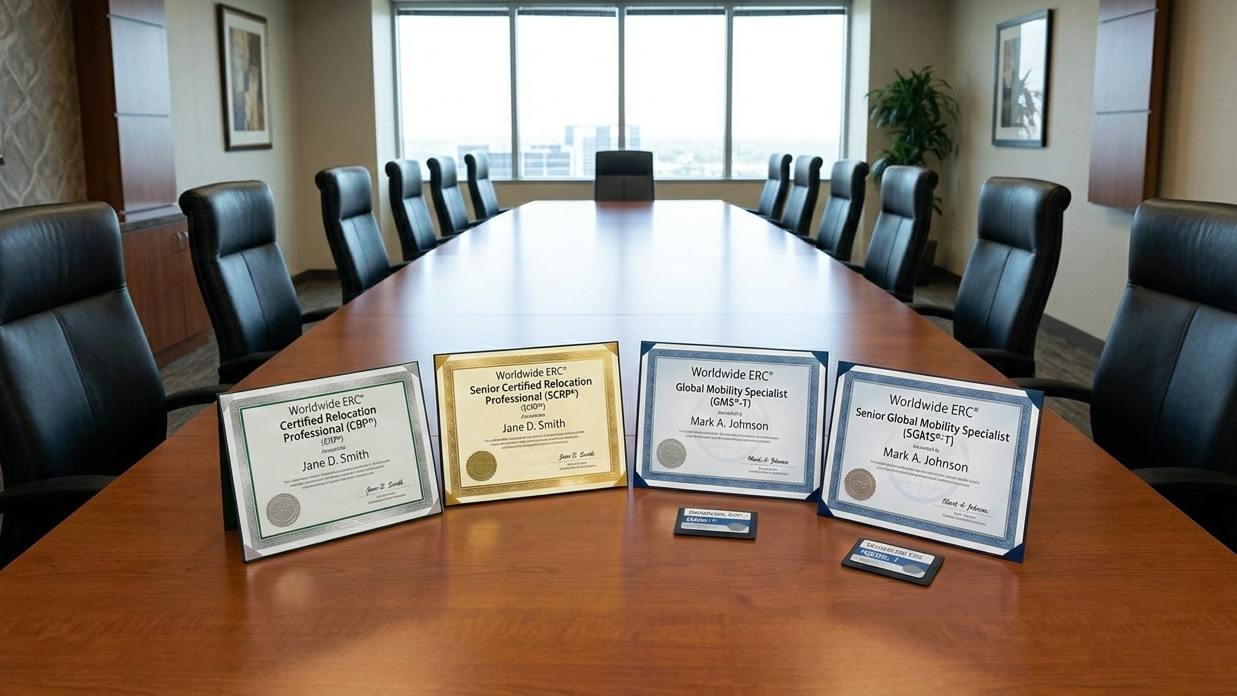
The relocation industry moves fast. Companies are sending employees across borders more than ever, and the people managing those moves need more than just general HR knowledge. They need to understand taxes, immigration rules, housing markets, and international compliance. That's where professional credentials come in.
A global mobility certification is a way to prove you have that specialized knowledge - not just to employers, but to yourself. These programs cover everything from cross-border tax compliance to supporting an employee whose family is moving to a country they've never lived in. If you're working in - or looking to break into - corporate relocation, understanding which credentials exist and what they cover is a smart first step.
CRP Designation: Certified Relocation Professional Explained
The CRP designation is one of the most recognized titles in the relocation field. It's managed by Worldwide ERC® (WERC) and focused specifically on the US domestic relocation market. If your work involves moving employees within the United States, this is the credential built for you.
The certified relocation professional program covers the nuts and bolts of domestic moves: real estate, household goods shipping, relocation policy, tax and legal considerations, and working with service providers such as moving companies and real estate agents. It also addresses something that often gets overlooked in corporate settings - the emotional side of moving and how it affects employees and their families.
To earn the CRP designation, you need at least one year of experience in corporate relocation and an active WERC membership. The exam has 125 multiple-choice questions (110 are scored), and you have three hours to complete it. Topics include policy development, relocation appraisals, domestic tax and legal issues, and vendor management.
Once you pass, the designation must be renewed every 3 years, requiring 30 hours of continuing education. That ongoing requirement is actually a feature, not a burden - it keeps you up to date on regulatory changes and industry shifts.
For relocation managers, this credential signals that you can handle the financial and legal complexity of a move. For service providers - real estate agents, moving company owners, destination services consultants - it builds credibility with corporate clients and shows you understand their world.
GMS Certification and GMS-T: Tax-Focused Mobility Expertise
The CRP designation is great for US moves, but what if your work takes you global? That's where the GMS certification comes in. GMS stands for Global Mobility Specialist, and the program is designed for HR and mobility professionals who manage international assignments.
The industry has shifted significantly in recent years, and so has this credential. WERC updated the program in 2021, combining the original GMS curriculum with a Strategic Talent Mobility course. The result is the GMS-T - the "T" standing for Talent Management. If you're new to the field, this is what you'll be working toward from the start.
The GMS-T program is structured around six online modules:
- Introduction to Global Programs
- Policy Development and Assignment Management
- Immigration and Visas
- International Tax and Social Security
- Compensation and Payroll
- Intercultural Management
If you already hold an older GMS certification, you don't have to start from scratch. You can take the Strategic Talent Mobility course as a standalone upgrade to earn the "T" status.
This path is particularly well-suited for people focused on the technical side of international mobility - tax equalization, shadow payroll, and global compliance. These are areas where getting something wrong can cost a company serious money, and having the credential shows you know how to navigate them.
SCRP and SGMS-T: Advanced Credentials for Senior Leaders
For a Global Mobility Specialist who's been in the field for several years and is ready to move into a leadership role, there are advanced versions of both credentials: the SCRP (Senior Certified Relocation Professional) and the SGMS-T (Senior Global Mobility Specialist - Talent).
These aren't just harder versions of the original exams. Earning senior status is about demonstrating that you contribute to the profession, not just practice it.
To reach the SCRP level, you need to hold a CRP already and accumulate "service points" through activities like:
- Speaking at industry conferences
- Writing articles for professional publications
- Serving on committees or boards within the mobility community
The SGMS-T works the same way for people on the global track.
Senior professionals in this field aren't just managing individual moves - they're designing a company's entire mobility strategy. That means:
- Policy design. Building flexible relocation programs that actually attract good candidates rather than pushing them away.
- Cost management. International moves are expensive. Senior leaders have to balance that cost against what the company is actually getting back.
- Compliance. Keeping the company out of trouble with foreign tax authorities, immigration rules, and employment law in multiple countries.
- Inclusivity. Making sure mobility programs work fairly for everyone - not just the most obvious candidates for international assignments.
These senior designations demonstrate that you can lead a team, present to senior executives, and shape a company's approach to talent development.
Choosing the Right Global Mobility Courses and Certification Path
With several options available, the right starting point depends on where you are in your career and where you want to go.
Just getting started? Look for introductory global mobility courses - many organizations, including WERC, offer foundational classes that don't require any prior experience or an exam. These are a good way to learn the basics of immigration terminology, the structures of relocation policy, and what the job actually involves day to day.
Once you have a year or so of experience, you can apply for the CRP or GMS-T exam. Budget for costs: between WERC membership, study materials, and the exam fee, you're likely looking at $500-$1,000. Many employers will cover this, since a credentialed employee is a better employee.
A simple roadmap:
- Year 1. Work in an HR or relocation role. Take a foundational course to build your knowledge base.
- Year 2. Join WERC and sit for the CRP or GMS-T exam.
- Years 3-5. Maintain your credential with continuing education. Start building your network - conferences, committees, and industry groups matter at this level.
- Year 6+. Accumulate service points and work toward your Senior designation.
A career in global mobility isn't just about logistics. It's about helping real people navigate some of the biggest transitions of their lives - new countries, new schools for their kids, new tax systems, new languages. The credentials in this field reflect that complexity, and earning them is a signal that you take it seriously.
If your work involves helping people relocate to the United States, or you're managing a corporate mobility program that includes US destinations, Expat US works with relocation professionals and HR teams across 150+ US cities. Get in touch to find out how we can support your program.

